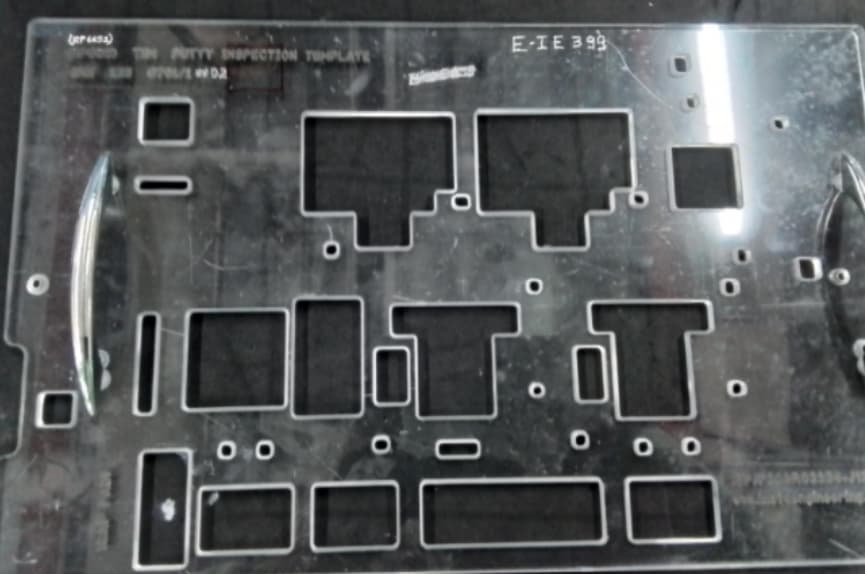
I need your help to confirm the correct ESD test method and ESD specification for a transparent acrylic template which is being used at PCBA level.
As of now, we are referring to STM4.1 worksurface standard for measuring point to point & points to ground readings of the template, with required spec <1.0*10^9ohm & <100Volts static voltage.
Please review and confirm if this is the correct ESD requirement to be followed or suggest any correction is required.
Unless you are doing work on your ESD sensitive items on top of this template, I don’t think ANSI/ESD STM4.1 would be appropriate.
I suggest you review section 8.3.1 in ANSI/ESD S20.20 on insulators. There it says “For initial process qualification and ongoing compliance verification measurements, one of the following criteria shall be met:
• Measure the field at the location where the ESDS item is handled. The electrostatic field shall be less than 5000 volts/meter (125 volts/inch).
or
• For any process essential insulators located less than or equal to 25 mm from an unprotected ESDS item, the voltage on the surface of the insulator shall be less than 125 volts when measured with a non-contact electrostatic voltmeter. When using an electrostatic field meter, the reading shall be less than 125 volts when measured at the meter’s stipulated measuring distance.
• For any process essential insulators located more than 25 mm, but less than 300 mm from an unprotected ESDS item, the voltage on the surface of the insulator shall be less than 2000 volts when measured with a non-contact electrostatic voltmeter. When using an electrostatic field meter, the reading shall be less than 2000 volts when measured at the meter’s stipulated measuring distance.”
I personally suggest the first method of measuring the field at the location where the ESDS item is handled but you can choose what you want. The method of doing these tests is in ESD TR53 section 7.3.1.
Hello ,
Greetings of the day from India to all the members on this platform.
Here, there are two things and it is a good question indeed .
As our ESDA Expert Andy Sir has mentioned, it is true that you need to follow the steps he has mentioned if you are using and ORDINARY Acrylic material as an PEI ( Process essential insulator )
Whereas ; if you are using an ESD safe coated Acrylic material as a top cover or as a housing to your PCBA, then in my opinion you are right to check it per STM4.1 but , only for P-P resistance .It may not be effective for Rtg test as it is not volumetric safe for ESD control. But once again here Andy Sir’s suggestion is to be considered as the material is not intrinsically ESD safe but treated as PEI.