If an operator is required to operate multiple pieces of equipment and performs mobile work, meaning only wireless wrist straps can be worn, while wired wrist straps pose a hazard due to the risk of being caught in the equipment. Are there any alternative protective measures available?
Hi Lucy,
First of all, wireless wrist straps do not work at all. If you want to see a demonstration, go to

If you cannot get to youtube there are many articals on wireless wirst straps.
If you want to ground your operators, then explore a footwear/flooring system. It can consist of a simple floor mat connector with heel straps or proper footwear.
Another solution would be to use a groundable garment system. This still has a wire to connect to ground but it ususally connected at the hip and not the wrist.
Hope this helps.
1 Like
Hi Lucy,
If operators need to move between multiple pieces of equipment, I would be cautious about relying on wireless or “cordless” anti-static wrist straps. They generally don’t provide the same reliable path to ground as a properly grounded wrist strap, so I wouldn’t consider them a direct replacement.
If wired wrist straps create a snagging or entanglement hazard, a footwear and flooring system may be a more practical solution. ESD footwear, used with a suitable ESD floor, allows operators to stay grounded as they move around the work area without having a cable connected to their wrist. Heel grounders may also be suitable in some environments, depending on the flooring and the level of mobility required.
Another option worth considering is a groundable ESD garment . These can provide a grounding point away from the wrist, which may help reduce the risk of cables getting caught while the operator is working.
The best approach will depend on the equipment being handled and the site’s overall ESD control programme. It may be worth speaking with an ESD specialist to assess the risks and choose the most suitable grounding method. Bondline, for example, supplies a range of ESD grounding and protection solutions, so their team may be able to help identify an option suited to a mobile working environment.
Greetings of the day from India to all the members on this forum’s platform and welcome to LUCY to the community 
CORDLESS WRIST BANDS CANNOT BE A SUBSTITUTE TO WRIST BANDS WITH GROUND CORDS WHICH ARE FOOL PROOF AND GUARANTEED FOR PERSONNEL GROUNDING IN SITTING POSTURE. IT IS NEITHER 100% PROVEN FACT AND NOR IS ACCEPTED BY ESD ASSOCIATION USA OR ANY OTHER AUTHORITY WORLD WIDE AND THERE IS NO INSTRUMENT TO TEST ITS WORTHINESS UNLIKE THE CONVENTIONAL WRIST BANDS WITH GROUND CORDS.
It operates using a combination of several physics phenomena like “Ion Neutralization, Skin Effect, Point Discharge and Corona Discharge Effect” combined with the principle of differential potential to collect and dissipate static electricity.
It is a combination of bio-industrial and electronic technologies. In effect, the wireless wrist strap slowly neutralizes static electricity on a human body and maintains the potential of a human body below 500V, which is a great improvement from 3 to 5 kV measured without the wrist strap.
But in the Electronics applications it is too High a voltage level to afford as many of the Semiconductor devices are susceptible even at lesser to 100v -30 v Do not use wireless wrist straps as your primary grounding device .
The wire less wrist strap’ s practical effectiveness could normally be checked using a charged plate analyzer ONLY putting it in decay mode. This was a practical demo I saw in an ESD awareness training session in Bangalore ( Karnataka- India ) in 2001 . It was a fast decay up to approx 500v, and then your body maintains the same level (approx 500v).
Following is a report from ESD Journal (UK) for your information.( almost around 3 decades old )
The following is a summary of evaluation of the strap: ( Abstracts FROM ESD Journal UK)
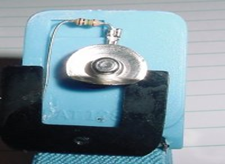
A cordless wrist strap at workbench connected with a common ground point tested and found to gradually reduce the static on a person “after 15 seconds.” which is too long.
• Tests showed that the wrist strap with cord had a resistance from the wearer’s hand to ground of 1.3 Meg Ohms. and upon grounding, it could bring down the body voltage to as less as 10 v in less than 2 secs
• Technician wore insulative shoes (> 10,000 MegOhms) and walked on an insulative floor and was charged to 2,000 volts.
• When he walked around with the Cordless wrist strap on, decay of the static charge to about 1,000 Volts only in 90 seconds was noticed
• When he walked around without the wrist strap even, a decay of the static charge to about 1,000 Volts in 90 seconds was noticed.
• There was no difference in the time to decay to 1,000 with or without the wrist strap in place.
• With cordless wrist strap on the walking technician, his potential never went below 700 volts for over 3 minutes.
Cordless wrist strap was dissected to see what inside would account for the claimed neutralization. Just found only a 1 Meg Ohm resistor as the same which is used as a protective resistor in the cord of a corded wrist strap. This supports the findings that the wireless wrist strap is no method for neutralizing a person if not connected to ground by a conventional cord.
Currently no methods available or devices exist which will effectively ground a person without a tethered cord to ground or at least a large capacitance.
As our ESD Guru JK Sir has mentioned, for mobile persons the best way out is to implement the Footwear -Flooring system. The ESDA demo he has referred is proof again on the inability of Cordless wrist band and this video must be watched .
It is due inadequate knowledge of the suppliers many items like this are used by the users inadvertently even today and inviting the ESD risks unknowingly.
Even ESD facility certified units are using this cordless wristbands even today . All due to ignorance of the ESD awareness. Facility certification has become a very casual thing despite these lapses every where.
Thank you .