Hello,
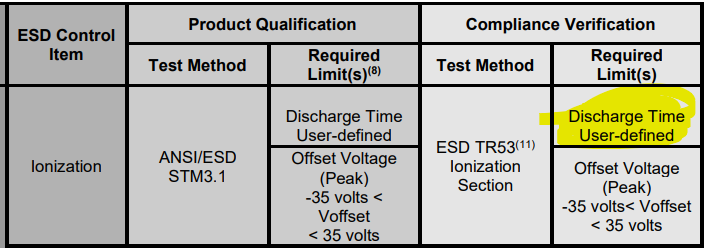
For 7.3.11 Ionization in TR53 Do I have to comply with 7.3.11.1 (Discharge Time) and 7.3.11.2 (Offset Voltage) or only one out of the two?
Thank you.
Hello,
For 7.3.11 Ionization in TR53 Do I have to comply with 7.3.11.1 (Discharge Time) and 7.3.11.2 (Offset Voltage) or only one out of the two?
Thank you.
Santiago,
ANSI/ESD S20.20 requires both discharge time and offset voltage comply with the requirements. The offset voltage test ensures the ionizer does not put out an unbalanced ion flow that could charge the ESDS item instead of reduce charge. The discharge time verifies the ionizer reduces charge within the user defined time. Both are important to ensure the ionizer works properly
Hi @AndyN ,
How can we define this “User-defined” discharge time? is there any method that can help us to define this adequately?
Thank you!
Santiago,
ESD TR20.20 says “The discharge time depends on the application. A short discharge time is usually required if the objective is to eliminate charge built up during a known charging process step. A longer discharge time may be defined to ensure that items do not become charged.”
IEC 61340-5-1 (the IEC version of ANSI/ESD S20.20) sets the discharge time to < 20 s (or user-defined per manufacturer manual / process needs).
I’ve seen facilities set their discharge times for typical desktop ionizers between 10 to 20 seconds. If you are using blow off gun ionizers, the discharge time could be much lower like 5 to 10 seconds based on the distance from the ionizer and the ESD sensitive items.
To be more rigorous about determining the discharge time needed, you would need to determine things like how much charging occurs, the sensitivity of your components, and the time between the charging and when the ionizer would need to reduce the voltage to the acceptable level before the ESD sensitive item is grounded. Since this is difficult to determine without a good process assessment, many companies determine what their ionizers can do when working properly and then set a discharge time a little higher to account for any drift but also to make sure the ionizers are working properly.
Greetings of the day from India to all the members on this forum 
Welcome back Mr.SantiagoE after a long time .
Andy Sir has given a detailed explanation.
In S 20 20 the decay time is mentioned as user defined but, in IEC 61340-5-1 it is <20 sec or user defined or per mfrs guidelines again.
But in general, the standard practice is that universally decay time is tested as the time it takes to reduce a static charge from ±1,000 Volts down to ±100 at 30 cm distance .
Now ; due to increasing CDM trend, as Andy Sir has highlighted a process assessment per SP17.1 of your activities in addition to the TR 53 CV test audit will provide you a better picture to set the decay time to your requirements.
However; regular cleaning of your Ionizer’s emitter is of very high importance to maintain its effectiveness for a proper static control.
Thank you