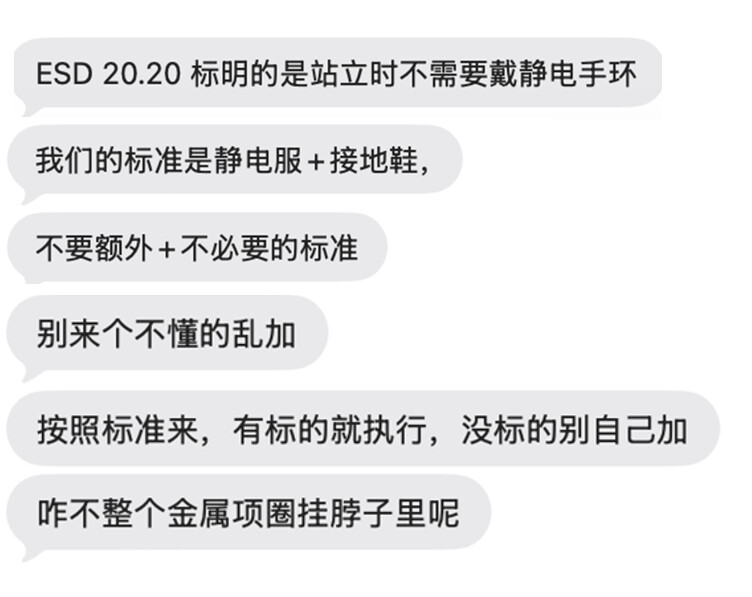
Dear Experts
Because ESD S20.20 and manual TR20.20 require standing work to be selected from two options, there are no details and more clear explanations, which leads to the understanding of the industry training institutions, third-party certification institutions, different customers, internal companies, and other personnel in various fields being different. They believe that wearing anti-static shoes and cooperating with the floor can meet ESD protection requirements, and it is mandatory for enterprises to “not wear wristbands when standing.” They also believe that ESD S20.20 indicates that “wristbands are not required when standing,” and they do not recognize the professional staff’s explanations and the company’s internal document control requirements other than ESD S20. They believe that the following explanations and document definitions are extremely unprofessional. Because different people repeatedly request changes (some people think it is right) and cancellations (some people think it is not right), it causes trouble for the industry and company management and is very helpless. They can only passively accept different results in different situations. We hope that all experts can give more professional answers and support, help confirm whether the following clauses should not be added, and at the same time, we hope that all experts can evaluate and consider whether it is necessary to include similar issues in the interpretation and notes of the revised standard clauses. Thank you very much.
Personnel standing operation: The grounding method must be chosen from two options: ① Electrostatic wristband system; ② Must meet the requirements of the “Table 2” shoe-floor system
① During the personnel operation, if they choose to be grounded only by the wristband: Personnel standing must be grounded through the wristband (a strict condition)
② If they choose not to wear the wristband while standing: Must meet the resistance and walking voltage requirements of “Shoe-Floor System” in Table 2 (a strict condition)
→ Human body → Shoes → Floor → Total resistance of the common grounding point 1×10⁶Ω to 1×10⁹Ω
→ The walking voltage of the human body must be less than 100V
II. The internal ESD control system of the company has been enhanced by incorporating process behavior control and comprehensive human body testing, as well as requirements for special “standing workstations” (rigid conditions) for handling high ESD-sensitive components. These measures are based on the product sensitivity level and process risk assessment.
① When personnel are standing without wearing wristbands: In addition to meeting the requirements of Table 2 in ESD20, throughout the operation, both feet must remain in continuous contact with the anti-static floor. They are not allowed to stand on tiptoe, lift their feet, step on insulating foot mats, shoe soles, or the floor. The floor must be kept clean and tested to be qualified.
② Material transfer and inspection, do not directly touch the chip body, cannot wear anti-static wristband position, can use “shoe-floor system” to replace wristband, but must conduct human body comprehensive impedance test
③ When working at special “standing positions” for handling highly ESD-sensitive devices, it is necessary to prioritize the use of wired electrostatic wrist straps and the shoe-floor system as supplementary measures to enhance protection. These should not be regarded as the sole grounding requirements.
④Every time personnel enter the workshop, they must pass the comprehensive human body impedance test.
Here is what ANSI/ESD S20.20 requires. I am using the English version as that is the version to be used in case of any misinterpertation.
The requirement for personnel is to conneted them to the selected grounding/bonding system that has been defined. This is a shall statement and the base requirement.
To implement this, a user can select three methods, a wrist strap system, a groundable static control garment system ore a footwear/flooring system. There are no requirements on which system to use. An orginization or company can choose one or all of these systems to connect personnel to the grounding system.
Once choosen, the system shall meet the requriements of the system. For wrist straps, the total system resistance shall be less than 3.5x10E7 ohms. This requirement is in line with most wrist strap systems as they typically have 1x10E6 ohm resistor in the curcuit. A wirst strap system can be used by standing or seated operations. A groundable static control garment system has the same requirements as a wirst strap system with an additional requirement for the garment. It can also be used with standing or seated operations.
If a footwear/floor system is choosen, it shall meet the requirements of a system resistance of less than 1x10E9 ohms and a body voltage or walking test of less than 100 volts. This needs to be with every combination of footwear and floors used in the process. This system can only be used with standing operations. Once seated, a wrist strap system shall be used. The standard has a strict requiremetns on seated operations.
Right now there are no definitions for special workstations. This would be highly dependent on the actual sensitivties of the devices themselves and the process. While the suggestions are good, they do not have any hard requirements of what is special. A typical wrist strap system can keep personnel below 10 volts which might be enough. There are also footwear/flooring system that can keep personnel below 25 volts. It depends on what is trying to protect.
As far as testing that the system is working, a compliance verification program needs to be developed. ANSI/ESD S20.20 does not specify the interval in testing but requires a usere to define it. This is usually based on seneitivies an risk level for the devices.
ANSI/ESD S20.20 and IEC 61340-5-1 requires program managers that need to define indivigual processes based on device sensitivies, device costs and defined risks. Using these standards, and ANSI/ESD SP17.1 will help define the critical requirements for ESD control.
Dear Mr. JohnK
Thank you very much for your professional answer.
According to your answer, can I understand that when using the “shoe sole grounding system” for grounding, it is still necessary to meet the requirements of Table 2 of ESD S20.20? For example, if the enterprise only meets the new product certification (based on the supplier’s verification results), but fails to meet the compliance verification requirements of Table 2, does it still need to wear an electrostatic wristband when standing?
Thank you very much!
Failure to meet the requirements of the compliance verificaton would be a non-conformance to the standard and would be a failure of the process. If the supplier is providing the product qualification data, that must include the qualification of the floor, the footwear and the body voltage (walking test) for a footwear/flooring system.
The user must have a compliance verification procedure for the floor and the footwear system. A footwear system is the resistance from a person’s hand to a test plate.
If any of these steps are not done, then the footwear/flooring system is not compliant with the standard. If this is the primary way to ground personnel it would be a major non-conformance.
An alternate way to ground personnel would be a wrist strap system. That is the choice that the organization or company must make.
Please feel free to ask more questions.
Thank you very much for your clear, professional and patient explanations. These answers are of great significance and great help in unifying the understanding of different professional levels within the industry regarding electrostatic discharge (ESD) protection, as well as in standardizing related practices.
Once again to express gratitude for your patient and thorough response during your busy schedule. Thank you very much.
As we know, should the doctor washing hands or feet before the surgical operation?
For the hands will be more closed with product than feet, the risk is absolutely existent base on the surface R of body.
So, the foot-floor system is the consession method.