Industrial practice for verification of ESD packaging

Dear Experts.

I have issue in implementing the ESD packaging verification as the ESD package does not contain the same product after going thru work process in batch on fabrication, Testing, QC inspection and environmental testing. Can i use number of lifecycles or ESD package shelf-life to determine the usage before discard?

1 Like

Rachel,

I think it would be okay to use a number of lifecycles or the shelf-life to set your compliance verification interval of the packaging. Once the reusable packaging reaches this time interval, instead of discarding it, I recommend testing it and if it meets the resistance limits in ANSI/ESD S20.20, it should be good for continued use.

Hello,
Welcome to the Forum and Greetings of the day from India , to all on the forum platform. Good question indeed.
You did not mention what type of bag you are using .
Basically these packing items ( bags ) need to be considered for a single use to protect the ESSDs and to avoid possible damages to the ESSDs inside. However, many use them for multiple applications> There is no definite number of life cycle but as our Andy Sir has mentioned you may set an interval in your ESD control plan and verify its compliance per ESD standards followed by you.
Especially that, if you are using metallised Static shielding bags due to folding of the bags during multiple applications it is likely that the thin vaporized metal layer may develop some hairline cracks which may not be visible to naked eyes but looses its static shielding efficacy . Further, at times the solder spikes on the populated boards puncher the surface of the bags and even a very tiny hole is good enough to allow external field voltage to penetrate and damage the device inside . Though by resistance parameter it may pass, it would be at risk every time when a bag is reused .

Rachel,

It is interesting that I assumed your ESD packaging was something like a reusable tote and G.N. assumed it was a shielded bag. Can you please clarify what ESD packaging you are referring to?

Hi

yes, am using shielded bag as transporting across facilities for different process and storage as well.

What is the recommended life cycles? Some OEM mentioned in a controlled environment, ESD bags can have 5 years of proven shelf life? Will this be able to put in practice as verification?

Rachel,

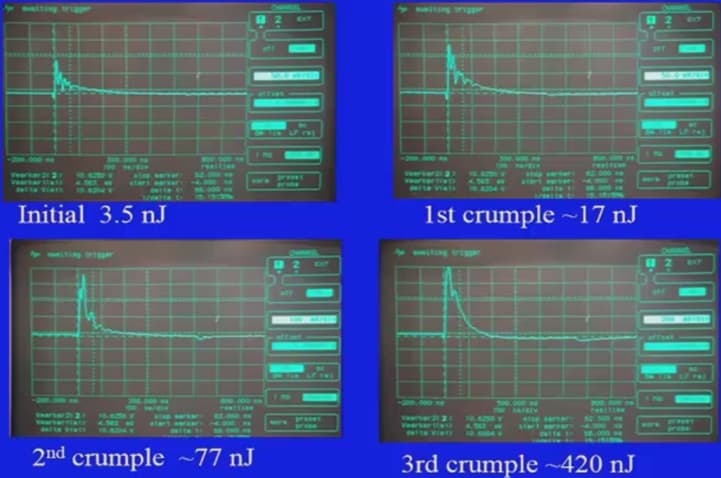
If you are re-using the same ESD shielded bag, I would recommend to stop this practice and move to an ESD tote. ESD bags are designed for single use. After repeated use, the metal layers tend to bend and break removing the ability of it to attenuate the discharge around the bag. Below is a picture of testing that happened on shielded bags after repeated use. As you can see, after the first crumple, the bag is almost at the ANSI/ESD S20.20 limit of 20 nJ. By the second crumple, it is outside the limit.

1 Like

Andy
Thanks for sharing the “crumple” measurements. This is a great visual for understanding effect of use.

Greetings of the day from India to all.

Thank you Andy Sir with your Practical justification.
You all experts are practical where as I talk only on my CV auditing experience.and theory.
Thank you again for the nice display.

Normally , I consider bags and foams as packaging items and the tote boxes / crates /bins as storage and transport items per my observations and site visit experience.
Thus, I assumed it as Static shielding bag which is the widely acceptable ESD safe bag.

Good day

Just to give the appropriate credit. The crumple picture came from an ESDA training given by Dave Swenson.

1 Like

Sir,
Greetings of the day from India .
Thank you Sir .
My heartfelt thanks to Swenson Sir .
Yesterday , I have shared this info and picture to my colleague Engineers /CV Auditors and have requested them to join the forum to interact and gain from the practical experience of various ESDA experts and other experienced stalwarts in this forum.

Especially in India , I do not understand how the so called certified bodies Assessors are giving the green signal for the facility certification when there are lot many compliance lapses wherever I have seen. Many are not even aware of the proper application what they are using and no record of any internal audits/ no PQ reports etc. How such facility certifications carry any value ? Assessors do not have any instruments and many a times even the user do not have the required right instruments or even if they have, many do not even ever use or get the calibration done regularly . Perhaps ESDA need to look into this seriously as CV audit test certification of an EPA is more important than a Facility certification on just a documentation evidence . When the compliance is not there what is the value quality management or a facility certification just on documents basis ? ESDA should rather identify in all countries good experienced or trained ESD control CV auditors to certify the EPAs mainly , after a thorough audit where the real activity takes place. Hope ESDA experts will look into this area seriously…

Once again many many thanks to all the ESD experts on the forum

Dave asked me to credit the ESDA class the crumple chart came from. It was from the Program Manager course on Packaging (FC200).

Thank you again Andy Sir.

Thanks to ESDA team for such good and informative practical examples.

It is really a fantastic experience every day on this wonderful platform provided by ESDA.
Thanks to ESDA team again :pray::+1::ok_hand:

Thank you for raising your concerns and for your engagement with the forum. It’s always appropriate to question the value of any certification program when expectations and understanding differ.

That said, there are some important clarifications needed regarding the ESD Association Facility Certification program and the role of Lead Assessors.

Facility Certification audits are conducted by ISO 9001 Lead Assessors from accredited Certification Bodies, who must also meet specific ESDA qualification requirements. These assessors operate under highly regulated, audited, and documented processes—both from their Certification Body and from ESDA. This is not an informal or loosely governed activity.

A key point of misunderstanding appears to be the purpose and methodology of a Facility Certification audit.
Facility Certification is not a CV audit and not a measurement-based verification activity. Lead Assessors are not expected to perform measurements or use instruments, nor should they. Their role is to evaluate:

  • The management system
  • Documented processes
  • Evidence of compliance verification
  • Training, qualification, and internal audit programs
  • Correct implementation and control of ESD processes per ANSI/ESD S20.20

The use of instruments, calibration, and measurement data is absolutely part of a compliant ESD control program—but it is the organization’s responsibility to demonstrate that these activities are properly defined, executed, and maintained. The assessor evaluates the system and evidence, not by re-auditing measurements in the field.

It’s also important to distinguish between:

  • Facility Certification (management system compliance to ANSI/ESD S20.20), and
  • Compliance Verification (CV) audits, which are operational, measurement-focused activities carried out by trained personnel within the organization.

Both are important, but they serve different purposes and are intentionally separated to preserve audit integrity and consistency with international conformity assessment practices.

If there are concerns about a specific certification, assessor, or Certification Body, ESDA takes such matters very seriously and has defined processes to review and investigate them. Broad public claims without case-specific verification, however, can unintentionally misrepresent a program that is built on rigor, oversight, and continual improvement.

Constructive feedback is always welcome, and ESDA continuously evaluates and strengthens its programs. For concerns tied to particular audits or regions, the appropriate next step is direct engagement with ESDA so facts can be reviewed objectively.

Thank you again for contributing to the discussion and for your continued commitment to advancing effective ESD control worldwide.
Greetings of the day from India to all and thank you Sir/s ( ESDA team) for your quick review on my post.

Thank you for all the details you have furnished and I am aware of it.

I am 71 , an ESDA certified ECPA and IS0 9001 LA certified too, basically a free lancer in ESD control and not working or worked for any a global Auditing agency . I do CV audit and PQ test as a third party .While I do not want to specify any agency or any user , it is my observation I have put in above . I strongly support for Compliance on top and then the quality will automatically follow . First Compliance is the foundation and then Quality is the top. But , Compliance is overlooked and only documentary evidence is given the importance . Many users just using the ESD control items without any training–or internal audit-or with required Test & Measuring instruments but directly asking and going for Facility certification and getting it within months to show the certificate to their vendors because vendor needs facility certification but not CV audit certification.

Many users do not even aware of the differences between P Q - CV - Facility certification, about ANSI ESD S 20 20 or IEC 61340-5-1 standards and relevant test methods. This way , we third party trained certified CV auditors do not get chances in many cases and the industry is ignoring the importance of compliance just believing on the basis of suppliers assurance /data sheets or just two lines PQ report as suppliers are more keen on pushing their items ( more of them being traders).

Sometimes we get call for just for floor test two days before the final facility certification but have found the EPA not compliant to ANSI ESD S.20.20. /IEC 61340-5-1 on many issues but still two days later the facility audit getting passed for grant of facility certification .

That is my concern as I am in this line over two decades plus only concentrating on the PQ-CV part having done iNARTE certification and DESCO trg program certificates in the recent years .

After seeing all these lapses, of late I wanted to become facility Assessor and thus did CQI-IRCA’s ISO 9001 LA certification trg two years before but unfortunately due to age factor no agency did extend me an opportunity to make my dream come true . Thus , just to remain satisfied , last year I did ESDA ‘s’ ECPA certification to satisfy myself to compensate my dream of becoming an ESD facility Assessor. I am now a life member of ESDA and enjoy interacting with experts on this platform. Occasionally, get calls for CV audits /floor tests/PQ tests and enjoying the field I am into.

Thank you once again for your quick response and look forward always for your valuable guidance to the industry.