Dear all:
My company is located in China. In our company, for each piece of equipment, in addition to requiring electrical grounding, an extra static grounding connection is also necessary. In this background, I have some doubts regarding the grounding requirements in ESD S20.20. I hope that all experts can help me understand them. . Firstly, what does the grounding conductor of the equipment refer to? The standard requires it to be less than 1 ohm. So, how exactly should one measure it using a multimeter? The second question: I understand that the auxiliary grounding refers to the resistance value between the electrical ground and the static ground. Is this understanding correct? If it’s incorrect, could you provide an example of common auxiliary grounding found in the EPA?
Sameer,
The equipment grounding conductor in ANSI/ESD S20.20 refers to the ground that factory equipment is typically grounded to. In European standards it is referred to as protective earth. If your factory is using this as its means for a grounding/bonding system, then the requirement is < 1.0 ohm impedance, although this measurement is not required if the factory has ground fault circuit interrupters (GFCIs) installed. The impedance is typically measured by using a circuit tester connected to a grounded outlet.
It appears you are using a separate static grounding system, which I have heard is required in China. If this is true, then that could be considered an auxiliary grounding/bonding system. The requirement is the auxiliary ground should be < 25 ohms to the equipment grounding conductor. This could be measured using a multimeter between a static grounding point and an equipment grounding connection point.
Auxiliary grounding/bonding systems are typically found where an organization wants a separate grounding system to connect parts to ground for reasons other than safety. In European standards it is referred to as functional ground.
On the piont of measuring the ground requirement of less than 1 ohm impedence, that requirement is for the USA only. In China I beleive the requirement is less than 4 ohms. In the next release of ANSI/ESD S20.20 the requirement for ground (or protective earth) will be what the national electic code is for your country.
To measure that you would need an impedence meter, not a typical multimeter that measure using a DC voltage. Using a DC multimeter would usualy result in strange measurements. This is usually due to noise on the ground line from the power system or the equipment in the manufacturing line. They only time that a DC type of measurement will yeild good result would be if all the equipment on the manufacturing floor was powered off.
S6.1 refers to the grounding system
- Equipment conductor grounding : This refers to the electrostatic grounding system that directly uses the power supply grounding conductor / PE line (what we in China refer to as “equipment grounding”). Resistance requirement: < 1 Ω.
- Auxiliary grounding : This refers to a dedicated electrostatic grounding system. The resistance between this system and the power supply grounding conductor / PE line must be < 25 Ω.
- Equipotential bonding : This refers to the practice of connecting all static-sensitive items (such as workbenches, anti-static floor mats, wrist strap grounding jacks) together in situations where direct grounding is not feasible.
Greetings of the day from India to all the members on this platform and a warm welcome to Mr.Sameer to our community 
Well , already our ESDA experts JK Sir & Andy Sir have shared detailed explanation to your queries and , our colleague member Mr. tingjunyang from China only has given you full clarification w.r.t ANSI ESD S 6.1 applicable to grounding system.
However, in most of the cases( at least in India I am referring to ) as a safety measure many users prefer a separate ESD earth ie. an auxiliary earth which will be connected to the equipment earth to maintain equi potential.
Perhaps in China as JK Sir has mentioned it is the national electricity guideline that you need to follow which is again as per the IEC standard as mentioned by Andy Sir
Per both the standards while connection to direct EG is the preferred earth, in which case the impedance shall be <1 ohms per ansi esd s6.1 and as stated by JK Sir & Andy Sir, you would need an impedance meter to measure it and not the usual multi meter.
Thank you
I’m very sorry for replying to you so late. Thank you for your explanation. I’ve already understood it.
Your explanation is very easy to understand. Thank you.
Thank you, JK sir,when I was using the multimeter to measure the resistance, I did notice some noise. Now I have understood the reason behind it. Thank you for the explanation.
Thanks to every expert who helped me solve the problem. I’ve understood it.
I can say one only, the 1 ohm is the best what I can do in my facility and it is very easy achievable in Europe area. So although electricians say 2 up to 3 ohms are OK as maximum in Europe (VAC is 230 volts), usage the 1 ohm makes the work more comfortable for noise reduction at ground wire. Remember - the power supply wires are very very long in factories and distance from plug place and switchboards sometimes is longer than 100 meters. The wire diameter must be sometimes better than only electric code required. S20.20 helps here.
Please better do not change it at new versions of S20.20 
The proposed wording in the next revision of ANSI/ESD S20.20 is
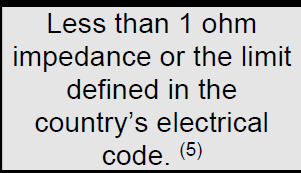
This allows for variance in electical codes. As far as noise reduction, there are many other parameters to consider and is really outside the scope of ANSI/ESD S20.20.
You are right. I wrote S20.20 helps (until new revision issue will take a place). Only technical attitude of the facilities designer shall take a game 
Again, your thinking is right about the scope of S20.20. But I was very very glad with the one ohm throughout my implementation of two new buildings and am sending thanks 