I am an engineer working in an industrial environment and I have a question regarding an ESD floor installed in a clean room.
The ESD floor is normally connected to a dedicated ESD grounding system (ESD GND), which is intended to be isolated and used only for ESD-related equipment. For testing purposes, I disconnected all ESD floor grounding cables from the ESD GND, so the floor should theoretically be floating and not connected to any ground.
However, when I measure the resistance between the ESD floor grounding cable and a nearby electrical protective earth (PE) outlet**, I measure approximately 20 Ω on one outlet and 3 Ω on another. I repeated the measurements and even disconnected the PE conductor at the outlet, but the readings persist.
My conclusion is that the PE grounding system is bonded to the ESD floor at multiple points, most likely through building steel, concrete, or other conductive paths.
My questions are:
Is it a problem for an ESD floor to be connected to **two different grounds (ESD GND and PE GND)?
From an ESD certification and compliance perspective (ANSI/ESD S20.20 / IEC 61340), could this dual grounding be an issue?
Should the ESD floor be bonded only to the ESD GND, or is bonding to PE ground acceptable or even recommended?
Thank you in advance for your help and technical insight.
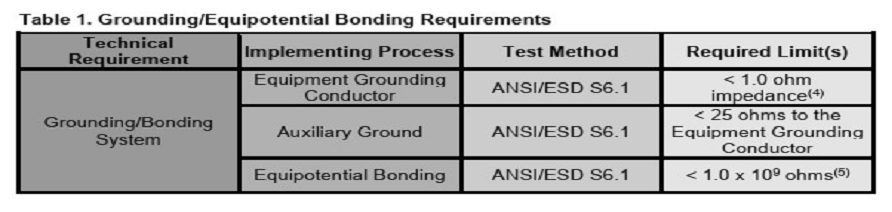
1.Basically , the preferred grounding connection to an EPE in an EPA is the EG or PE what you call as long as you ensure that there is no AC leakage and, in which case the requirement to be met is as per the table above and row 1 as applicable to Equipment grounding conductor .
But,in many places especially in India what I have seen and , I do suggest to my customers is to have an Auxiliary ground what you call as ESD ground basically as a safety measure, and in which case to maintain the equi potential it SHALL have to be bonded with the EG . In this case the requirement to be met is per row 2 of the above table
In such cases where you cannot have access to a physical ground (on ship /aircraft/on field service jobs etc) then the potential bonding is preferred by connecting to any available ground able object . In this case the requirement to be met is per row 3 of the above table
Thus, in your case as you have an exclusive ESD ground which is nothing but an auxiliary ground , it SHALL be bonded to your PE and the requirement to be met is per row 2 of the above table
As already pointed out, if you have an ESD ground system, it needs to be bonded to protective earth at some point. The limit in ANSI/ESD S20.20 is 25 ohms. In IEC 61340-5-1 it is what the countries national electical code requires or 25 ohms if a specification does not exsist.
This does not present a certification issue as long as the floor meets the resistance to ground requirements and the qualificaiton data is complete.