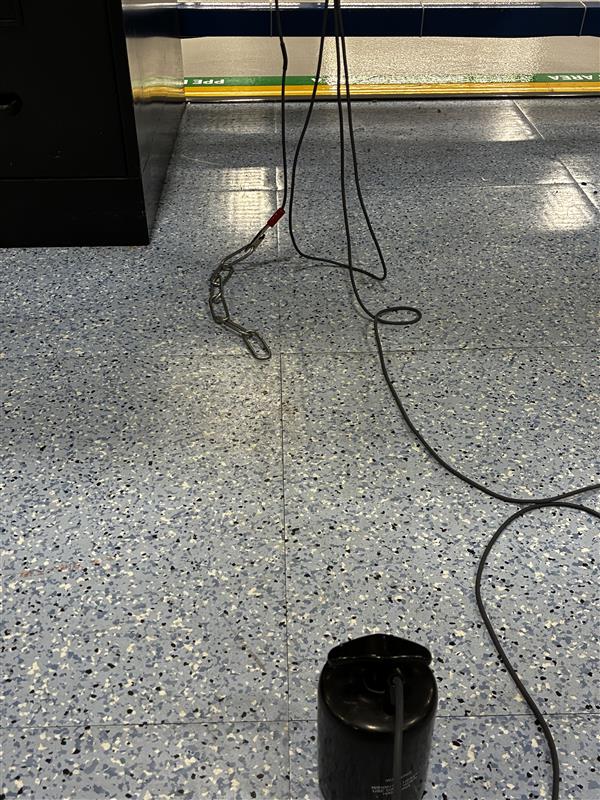
What are the best methods to test drag chains? After doing some testing, I’m finding it difficult to get a consistent and accurate test setup. Does anyone have a reliable method?
Current Test Setup. I also varied the number of links touching the floor.
The test method outlined in the picture is resonable. The results are the problems with drag chains making contact with the floor. Not sure if it is the drag chain or the floor at this point. If the floor is in the high resistance range, it makes it more difficult to overcome the contact resistance between the floor and the drag chain.
Heavy and longer drag chains have a better chance of making contact.
“Heavy and longer drag chains have a better chance of making contact.”
We’ve been noticing that ourselves. We’re also finding that the Link-to-Link resistance is very high with the two types of chains we have on site. Do you happen to have any recommendations on a type of chain to use?
I don’t have any recommendations. In my previous job we used conductive wheels on mobile equipment and hard wired fixed equipment.
We found the same issue as you are finding that drag chains we not reliable.
That being said, there are orginizations that I have been to that make drag chains work. I do not know what they used as I just measured the connection to ground.
Like John, we use conductive wheels on mobile equipment and hard wired fixed equipment. Some sites tried drag chains & asked for tests, which I carried out. The drag chains attempted were never reliable and we do not use them.
For most of my career leading ESD Control programs, we specified conductive wheels for mobile equipment used on ESD floors. For other mobile equipment we had a hard wire connection and a connection point on a stationary workstation connected to facility ground
We require both conductive casters and drag chains on our mobile carts. The chains are there more as “eye candy” for auditors and customers, but in combination with the conductive casters our verifications havent had issues.
It’s best if the trolley has grounding wheels. But sometimes the trolley is heavy, and wheels capable of supporting such a weight are very expensive. On the other hand, there are also areas in the factory where proper cleanliness is impossible, and in such cases, it’s best to use an additional chain dragged along the floor. I’ve found in my experience that it’s best to use a chain underneath the trolley, attached at one end to one edge of the trolley and at the other to the other edge. This ensures good contact with the floor, but it’s also easy to detect if the chain breaks – it simply slides out, making it impossible to move the trolley.
Hello ,
Greetings of the day from India to all.
In most of the transport systems and chair by default the suppliers does supply the respective EPEs with a ground chain too along with ESD safe wheels.
As wheels develop perfect contact with the ESD safe floor due to weight of the EPE I am of the opinion that it is the most preferred method as the reliability of chain is not guaranteed if it is just a chromium plated one and getting rusted over a period of time.
Further, a smaller and lighter chains do not make any sense many a times and as our colleagues above has expressed it is more of an eye wash . However , as our JK Sir has mentioned may be some long and heavy chains do help .
Hello,
I was wondering if someone can help with ESD chairs on an ESD floor. We monitor the floor and if kept clean the floor itself will measure within spec. The issue we have is that the chairs have ESD wheels and over time have become dirty and no longer read within the required spec. We verified this by testing a chair and having it fail and then cleaning the wheels on the chair and having the reading within specification. What might be the easiest way to clean the chair wheels so the ESD chair are compliant? Someone did state to add chains to the chairs but i am not sure that will make the readings compliant.
Thank you.
Hi Diane Plunske
It is common trouble noted everywhere in practice. Please do the trial with chain. I have heard a lot of solutions like a bundle of few chains from one screw onto floor surface and voices that it is working fine. Or the heavy metal ball laying onto the floor at the end of chain or spring conductive enough. But from my hand better is to use one or two metal wheels instead standard wheels. But sometimes they can make streaks on the floor, depends what the floor you use at your facility. The best solution - cleaning the floor and cleaning the wheels more frequently.
From second hand please consider if your chairs are really must being ESD protection items and keep the limit one G ohm. Are they use as protection items or only should be dissipative enough? A lot of facilities use field and voltage management or higher limits. Know that if you do not pick up chair as item (in standard it is optional) and put it into your plan - you do not have to use chair