At present, there are numerous adverse situations in the industry where people demand to replace the human body static electricity comprehensive testing instrument at the workshop entrance with electrostatic discharge balls. Many enterprises, fearing to offend customers, are accommodating all requests, resulting in the continuous expansion of this operation method. This has caused a significant obstacle to the professional control and standard implementation of ESD, disrupting the long-established control rules of the ESD standard protection system. In the current situation, do we have better methods to avoid or correct this unprofessional behavior, so as to prevent its continuous escalation?
As this type of non-compliant practice has been adopted by many enterprises and gradually become the industry’s default configuration, we are falling into a predicament of powerlessness and latent spread of issues, both in the interpretation of ESD standards and the implementation of risk controls. We need to enlist support from more professional experts and leverage standard clauses to reinforce the bottom line and consolidate the foundational basis of ESD control
look forward to your professional guidance. Thank you very much!
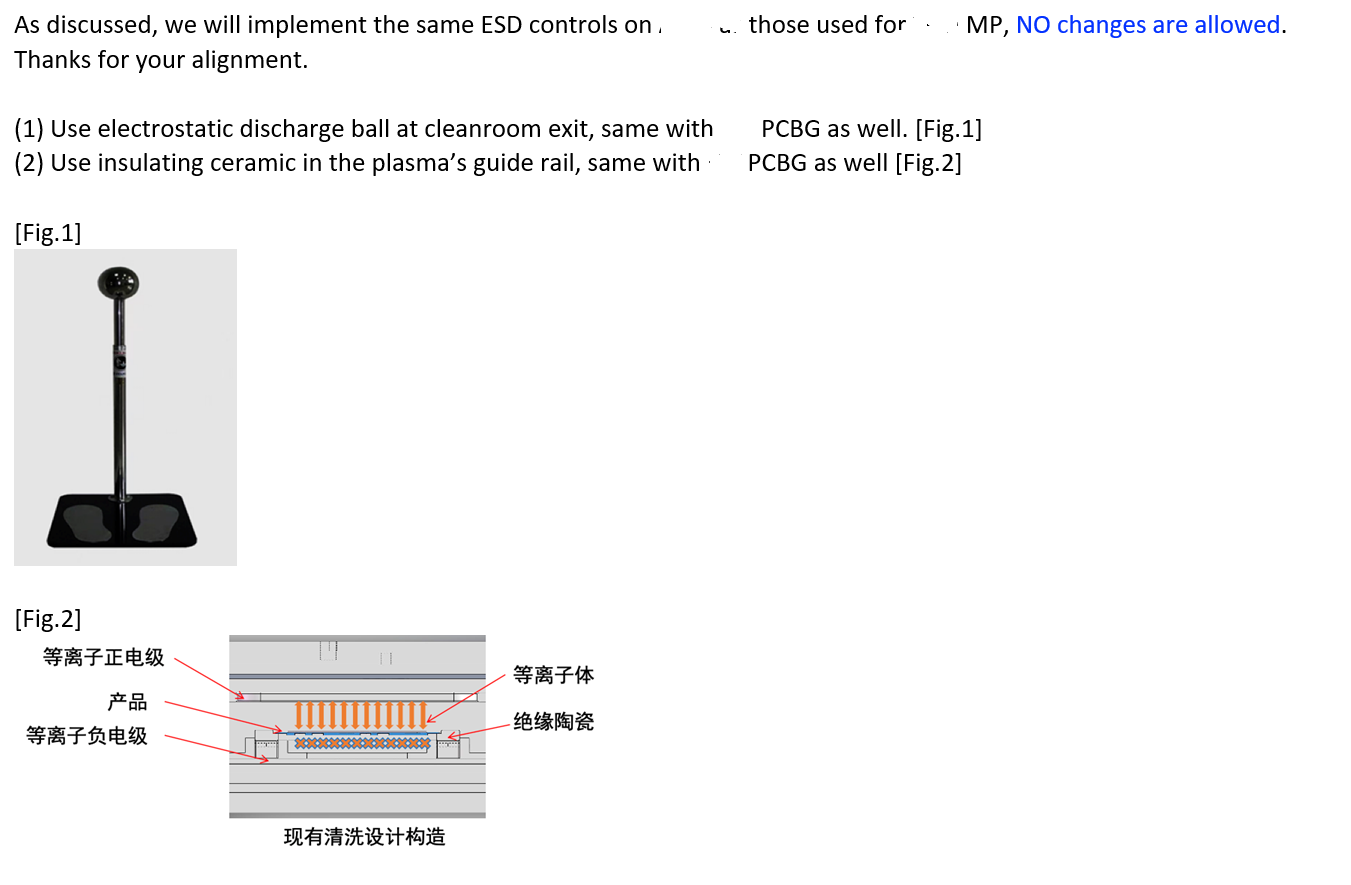
Human body electrostatic discharge release ball is designed for ESD-induced-ignition/explosion approach particularly adopted in petroleum industry (China) where personnel grounding system difficult to be implemented in many handling or inspection operations.
However, regarding electrostatic controls in electronic industries, personnel grounding thru wrist strap system or flooring-footwear system can guarantee human body safely low-charged. The guys claiming to introduce such discharge ball practice to electronic industry is absolutely technical backwards to electrostatic protection development to the whole electronic industry.
Relatively, I noted the plasma process (cleaning, or deposition, etching, etc) shall be more concerned about the correct charging control solutions.
Yes, thank you very much for your reply and suggestions. We also strongly oppose this practice. Whether from the perspective of standards, equipment suppliers, ESD protection expertise, on-site practical verification, product sensitivity, past ESD damage cases, etc., we have tried various methods to correct this behavior. However, some customers will follow the practices of other enterprises. The personal consciousness is too strong to be reversed.
While the static ball will drain a charge when touched, as soon as the person lets go, the voltage on the person will increase ( or decrease depending on the polarity). That is not acceptable. All personnel that handle ESD sensitive components must be connected physically to the grounding/bonding system. That ball is only good for the moment.
If a wrist strap is used, a person charged is drained in less than a second. If a footwear/flooring system is used, the person is constanly being discharged.
Yes,I fully agree with your conclusion. Thank you very much for your
professional interpretation of this ESD topic. Your clear reasoning has provided us with strong technical support to address such non-compliant practices across the industry .
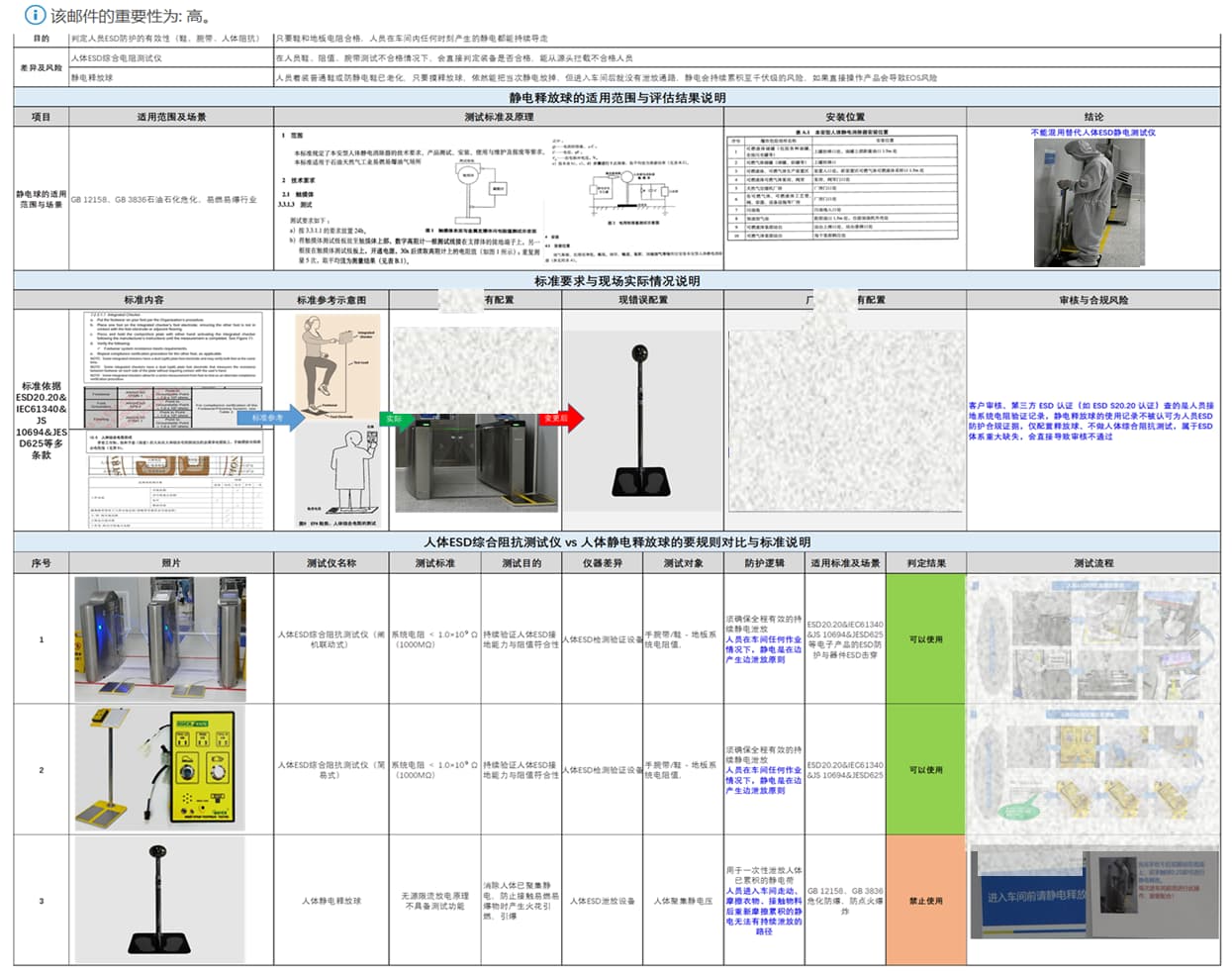
The static discharge ball only discharges charge momentarily on contact. It cannot measure the human body combined resistance of footwear-flooring system or check its compliance.
The entrance human static resistance test is used to confirm continuous grounding paths from wrist straps or footwear-flooring. Even after touching the ball to drain static before entry, movement and friction will rebuild static voltage. It cannot validate footwear-flooring resistance or detect missing/faulty wrist straps.
Thus, static balls are only auxiliary pre-discharge tools and must not replace the entrance human body static resistance test, nor confirm footwear-flooring grounding compliance or wrist strap wearing status.
As required by ANSI/ESD S20.20, operators handling ESD sensitive products need continuous charge dissipation instead of one-off transient discharge. Resistance measurement is mandatory to verify personnel grounding system functionality, which static balls cannot accomplish

 .
.