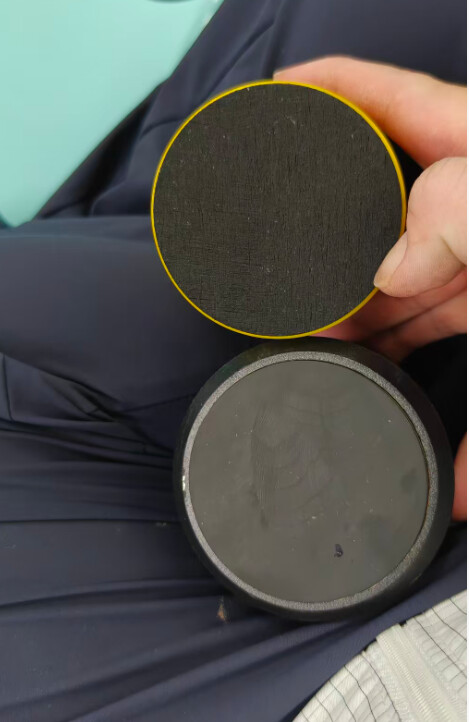
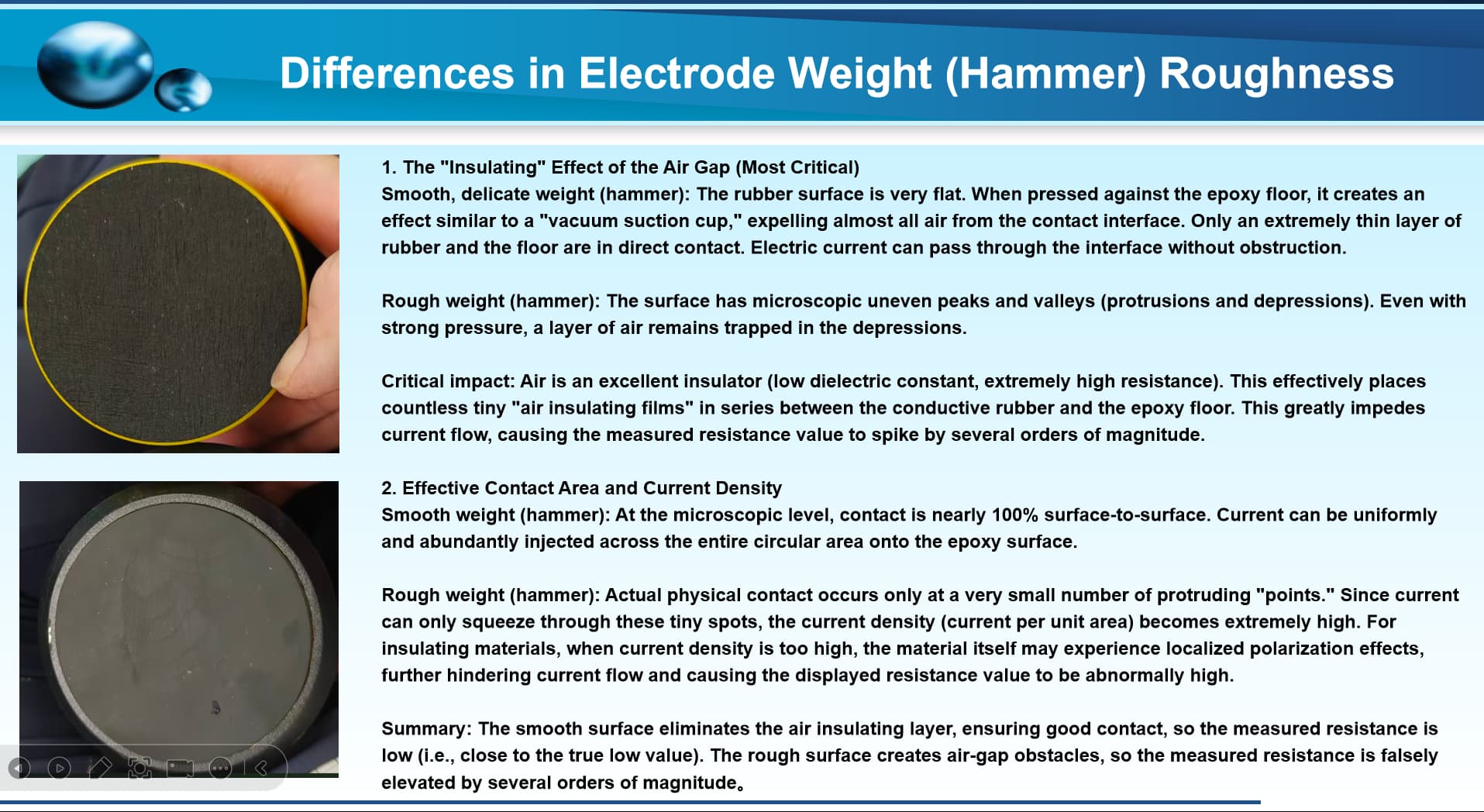
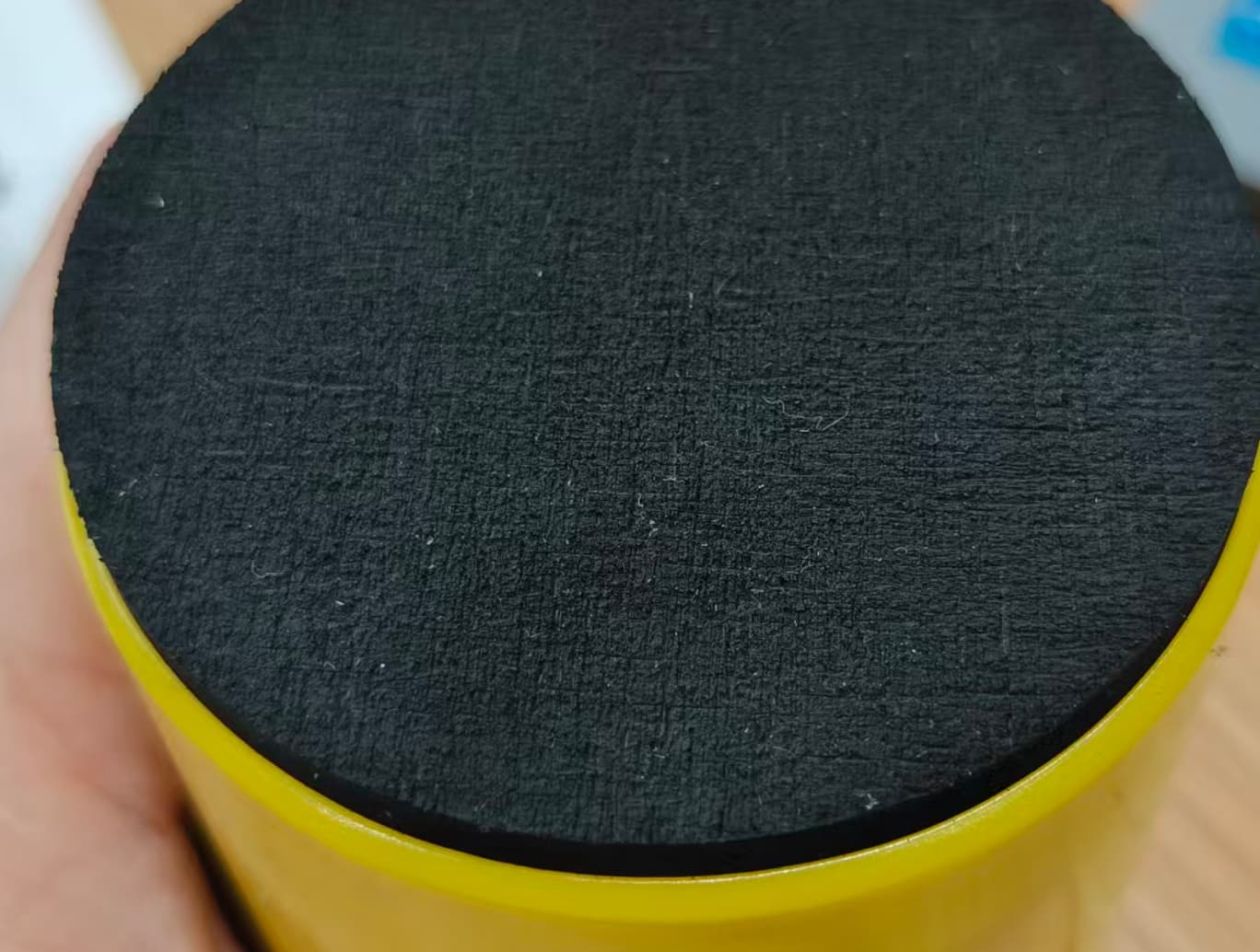
Today I observed an unusual phenomenon. Our company uses epoxy resin flooring throughout the building. On the second floor, when using a rough‑textured conductive rubber base electrode , the resistance measurements are consistently > 1.0×10⁹ Ω. However, when using a smooth, fine‑textured conductive rubber base electrode, the measurements are consistently around 1.0×10⁶ Ω – a difference of three orders of magnitude.
Our preliminary analysis suggests that the smooth, fine‑textured electrode makes better contact with the epoxy floor and even exhibits a certain degree of adhesion / tackiness to the surface, which significantly reduces the contact resistance and yields lower readings.
However, the puzzling part is that on other floors, which also have the same epoxy resin flooring, the measurement results are not affected by the electrode type – both rough and smooth electrodes give comparable values.
We would like to invite discussion on the possible root causes, particularly from the perspectives of floor installation/construction processes and test equipment / measurement methodology. What might be unique to the second floor that causes this electrode‑dependent behavior? Could it be related to differences in surface finish, curing conditions, topcoat formulation, contamination, or grounding practices? Any insights are welcome
Greetings of the day from India to all the members on the forum
I would wish to pen down my comments as under and look forward to ESDA experts views who are in the standards working group
What might be unique to the second floor that causes this electrode dependent behavior?
Could it be related to differences in surface finish, curing conditions, topcoat formulation, contamination, or grounding practices?
ANS: Can you please differentiate the two floors
When was the floor installed (both )?
What is the finish of both the floors? 3.What is the difference in top coat of both floors? 4. What was the curing time ? 5.What was the environmental condition maintained prior to testing of the floor? 6. At what ambient conditions the test was done, what was the total area and how many test have been done .? 7.Any difference in the wt. and dimensions of the electrode used, the resistance meter , its reliability and test voltage , SRM calibration date and accuracy etc. ?
Coming to the conductive rubber pads used at the bottom of the electrodes;
1.Direct metal surface of the testing electrodes may not develop perfect intimate contact with the surface under test leading to some air gaps which would give room for variation in the measurements. Thus the suggested conductive rubber pads per the test methods develop proper compression to develop perfect contact with the area of the surface under test with the standard 5-pound weight SS cylinders.
2.The surface finish of the conductive pads that come in contact with the surface under test should be smooth and fully leveled but not with rough or a grainy finished surface to ensure an uniform contact area with the surface under test.
3.Unlike PU foam the structure of either a conductive rubber pad or conductive EVA foam is slightly hard, the grainy or rough finish conductive rubber pads may deceive to develop the required intact surface contact area and may allow air gaps that would probably increase the resistance measurements leading to failure of the surface
Our facility initially utilized stainless steel heavy electrodes for floor resistance measurements. However, these proved to be unsuitable, as all readings on the epoxy flooring systems consistently exceeded the specified limits. Subsequently, we acquired a DESCO Model 19290 resistance meter. Testing with this instrument yielded satisfactory results on the 3rd, 4th, and 5th floors, with measured values all in the range of approximately 1.0×10⁶ Ω. In contrast, the 2nd floor failed to meet the acceptance criteria under the same ambient temperature and humidity conditions.
To investigate the discrepancy, we requested that the flooring supplier bring their own testing equipment, an ACL 800 meter, to perform on-site verification. Using the ACL 800, all floors, including the 2nd floor, passed the resistance tests. Furthermore, when we paired the DESCO 19290 meter with the ACL 800 heavy electrodes, the test results were also consistently within specification across all floors.
Upon closer examination, we identified a difference in the conductive rubber material used in the electrodes between the two instruments. Given that the flooring installation was completed several years ago, the supplier was unable to definitively confirm whether each floor had been constructed using material from the same production batch. However, visual inspection did reveal slight variations in surface appearance among the floors.
Based on these findings, we have concluded that the inconsistent test results are attributable to a combination of factors: the variation in conductive rubber composition of the electrodes, as well as potential differences in the installation or application practices employed by the supplier across different floors.
Can you please let me know how long ago did you purchase each electrode. I have not seen an electrode with the rough surface that you are showing. I will look into it.
Can you place the electrode on a metal plate and measure the resistance using 10 volts. That may help figure out what is going on.
Hello all, I have passed this information to DESCO. They are very interested to figure out what is going on with the probes. They will be looking into this and I will or Desco will post information in the forum.
Purchased about two months ago, it tested perfectly fine when placed on a metal plate. In this instance, the inconsistent readings between the two electrodes are suspected to be related to the conductive uniformity of the materials used by the epoxy floor supplier, or to the construction workmanship. However, such occurrences are indeed relatively rare. As I mentioned earlier, no discrepancies were found in tests conducted on other floors, and tests on other anti-static items using different electrodes also yielded normal results
Hi tingjunyang
Could you please share the result for shoes - I mean the system resistance from hand, throughout body, shoes, floor to grounding point.
So many years ago I had the problem when the people used heel straps onto the epoxy floor and everything were OK. Resistance and body voltage absolutely within limits. But we implemented the shoes, I checked really many pairs and brands. There was a trouble - epoxy worked only with real rubber - strap used onto heel. But the epoxy striked its cooperation with other materials as shoe soles. I disscused it with the producer, they said straight - theirs epoxy was designed directly only to be grounding for metals and highly conductive rubber. So, the trouble had to be solved by removing this kind of epoxy material due to no shoes on the market had been available with so conductive soles years ago.
Just a quick update.
DESCO has done an investigation and cannot duplicate the results above. There have been various reports of unexplained probe behavior but so far no pattern or conclusions can be made. While the DESCO probes are fine to use, DESCO has identifed improvements that can be made to the probes and is in the process on implimenting them.
Thanks to this forum and to DESCO to help improve measurements.